Place · Tamil Nadu
Auroville
About this place
Auroville is an experimental, international planned city in southern India (near Puducherry in the state of Tamil Nadu), which was founded on 28 February 1968 with the aim of realising human unity across all religions, nationalities and political beliefs. The spiritual vision was conceived by the Frenchwoman Mirra Alfassa (known as ‘The Mother’) and the Indian philosopher Sri Aurobindo, whilst the architectural masterplan was designed by the French architect Roger Anger.
The key features of the ‘City of the Future’
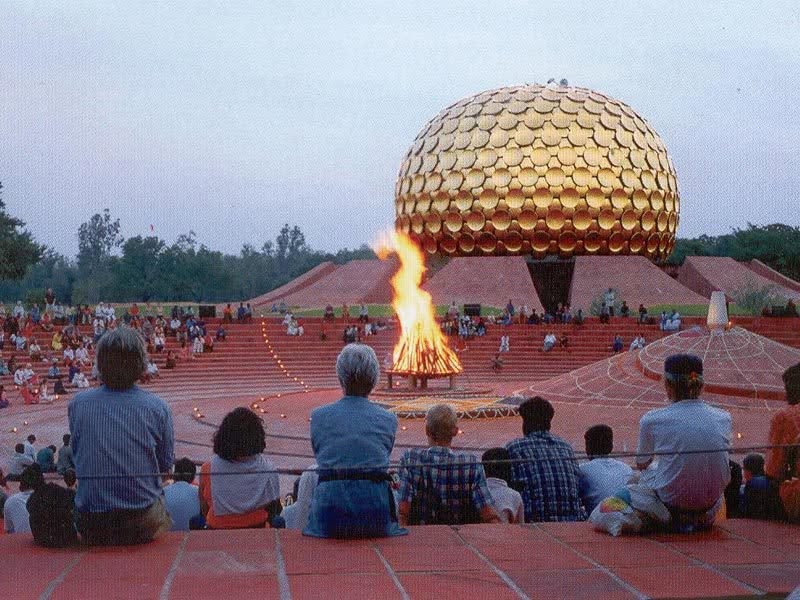
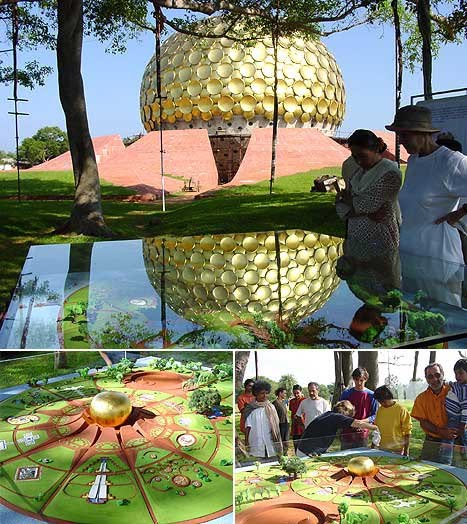
• The centrepiece: At the heart of Auroville stands the Matrimandir, a gigantic dome clad in gold-coloured metal panels. It serves as a place for quiet concentration and meditation and is intended as a symbol of a new, universal consciousness. • A cashless and property-free utopia: Land and houses in Auroville cannot be privately owned; there is only a right of use. The community is largely cashless and uses internal payment systems such as the ‘Aurocard’ for everyday life in cafés and shops. • Sustainability and environmental protection: Auroville is regarded as a global model for ecological construction, reforestation, low-tech innovations and organic farming. • International population: Today, around 3,300 people from some 60 nations live in the city. Around 45 per cent of the inhabitants are Indian, followed by larger communities from France and Germany. The original aim of the master plan envisages a capacity of up to 50,000 inhabitants.
Current challenges
Although the town remains a symbol of peace and alternative living for many, it faces real problems. In addition to the high financial barriers for young newcomers, there have been political power struggles for several years. The Indian government is increasingly interfering in the city’s self-governance via the Auroville Foundation in order to enforce the original, radical master plan (the ‘Galaxy Concept’), which is leading to heated debates amongst residents over tree felling and the preservation of the painstakingly reforested woodlands.
"The first necessity is the inner discovery in order to know what one truly is behind social, moral, cultural, racial and hereditary appearances. At the centre there is a being free, vast and knowing, who awaits our discovery and who ought to become the active centre of our being and our life in Auroville."
The Mother
Self-Governance
"Every organisation should remain supple and flexible so as to progress constantly and modify itself when the need arises." The Mother. 12 February, 1963
"Only those who have resolved to stay in Auroville for good have the right to intervene in its organisation." The Mother. 15 July, 1970
Self-governance in Auroville, based on Integral Yoga, is to foster unity and conscious collaboration among its members. Each individual and group must strive for inner growth and alignment with the divine will, ensuring that decisions and actions contribute to the collective harmony and evolution of the community, embodying the principles of truth, beauty, goodness, and the ideal of human unity.
Auroville belongs to nobody in particular. Auroville belongs to humanity as a whole. Visit & Stay Over the years, Auroville continues to attract people who are drawn to its ideals and vision. Besides people who feel an inner call to experience this unique place, there are others who come on brief visits in order to discover the essence and day-to-day functioning of the place. These pages offer some practical guidance for first time visitors.
The purpose behind Auroville The purpose of Auroville is to realise human unity – in diversity. Today Auroville is recognised as the first and only internationally endorsed ongoing experiment in human unity and transformation of consciousness.
When did Auroville start? On 28th February 1968, some 5,000 people assembled near the banyan tree at the centre of the future township for an inauguration ceremony attended by representatives of 124 nations, including all the States of India.
Where is Auroville? Auroville is located in south India, mostly in the State of Tamil Nadu (some parts are in the State of Puducherry), a few kilometres inland from the Coromandel Coast, approx 150 kms south of Chennai (previously Madras) and 10 kms north of the town of Puduchery