Trainings & Certifications
Practice deep,
teach with integrity.
200, 300, and 500 hour teacher trainings, somatic certifications, breathwork facilitator courses, and more, taught by experienced practitioners.
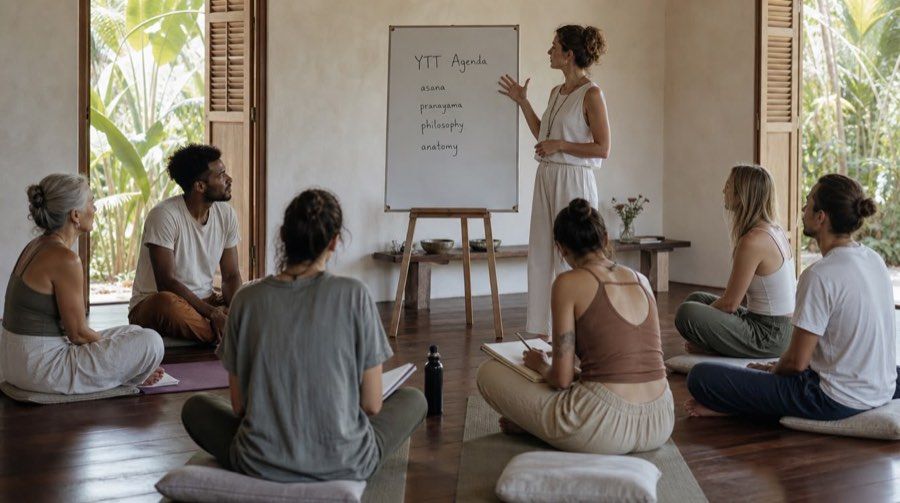
Teaching changes your own practice: you find out what you actually understand once you have to explain it. Arivela lists yoga teacher trainings at 200, 300 and 500 hours, breathwork facilitator courses, meditation and mindfulness teacher trainings, sound healing and somatic certifications, held by individual teachers and by established schools. Each one shows its hours, dates, language, what it costs and what you need to have practised beforehand, so you can compare them side by side.
Where trainings are held
Some people want a training they can travel to and finish in one stretch: a month in Bali or Rishikesh, three weeks in Portugal or Spain. Others need it to fit around work, spread over a series of weekends closer to home. Both exist here, and the format matters as much as the syllabus.
Intensive, modular, or online
An intensive gives you immersion, and a group that goes through it together. A modular training gives you months between blocks to actually absorb it. Online works well for theory and less well for the hands-on parts. Each listing says which it is, and you can filter by hours and location.
What a training asks of you, and what it costs
On Arivela you'll find 200, 300, and 500 hour yoga teacher trainings, breathwork facilitator courses, somatic and trauma-informed certifications, and more: taught by individual teachers as well as established schools.
Trainings span many lineages and styles, from Vinyasa, Hatha, and Ashtanga to Yin and Kundalini, alongside meditation, mindfulness, and bodywork trainings. Each training shows its length, location, language, and prerequisites at a glance.
Prerequisites, hours and cost
Most 200-hour yoga teacher trainings ask for a year or two of steady practice rather than any particular level, and a good school will tell you honestly if the timing is not right. Cost follows the format more than the hours: a residential month abroad usually includes accommodation and food, while a modular training at home often does not. Each listing sets out its prerequisites and what the fee covers.
Yoga Alliance registration matters if you plan to teach at studios that ask for it, and matters less if you are training for your own practice or for a different setting. It is worth deciding which you are doing before you compare. Many of these schools also run shorter workshops and retreats you can attend first. You can also look up the teachers who lead them, and the spaces where they teach.
Questions people ask
Usually a regular practice of a year or more, and no injury that would stop you practising daily for the duration. You do not need advanced postures. Most schools ask about your practice when you apply, and a good one will say if the timing is not right yet.
The format drives it more than the hours. A residential 200-hour month abroad usually bundles accommodation and meals into one fee. A modular training at home is often cheaper on paper but adds travel across the weekends. Online sits lowest. Each listing states what its fee includes.
200 hours is the standard first qualification and what most studios ask for. 300 hours is the advanced training you take afterwards. 500 refers to the two combined, either done together or accumulated over time. The numbers count contact hours, not calendar weeks.
A 200-hour intensive is typically three to four weeks residential. The same hours spread across weekend modules usually run six months to a year. Neither is better; it depends on whether you can step out of your life for a month.
In most countries nothing legally requires it, but studios, insurers and retreat centres generally do. If you plan to teach independently, the depth of your training and your own practice matter more. If you want studio work, check which registration they ask for before you enrol.